15 Surprising Facts About Indiana
A giant dune turned into glass, a jail with rotating cells, and two attempts at utopia: Indiana's stories go well beyond the racetrack.
1. The Indy 500 milk tradition took a detour through water
Louis Meyer celebrated his third Indianapolis 500 victory in 1936 with a bottle of buttermilk, a drink he already liked. Newsreel footage helped turn the moment into a racing tradition. It was not uninterrupted: winners received cold water in a silver chalice during the late 1940s and early 1950s. Milk returned in 1956 with a $400 incentive for the winning driver. What looks like an ancient sporting ritual grew from personal taste, a camera, and dairy-industry promotion.
2. The dunes helped scientists learn to read ecological time
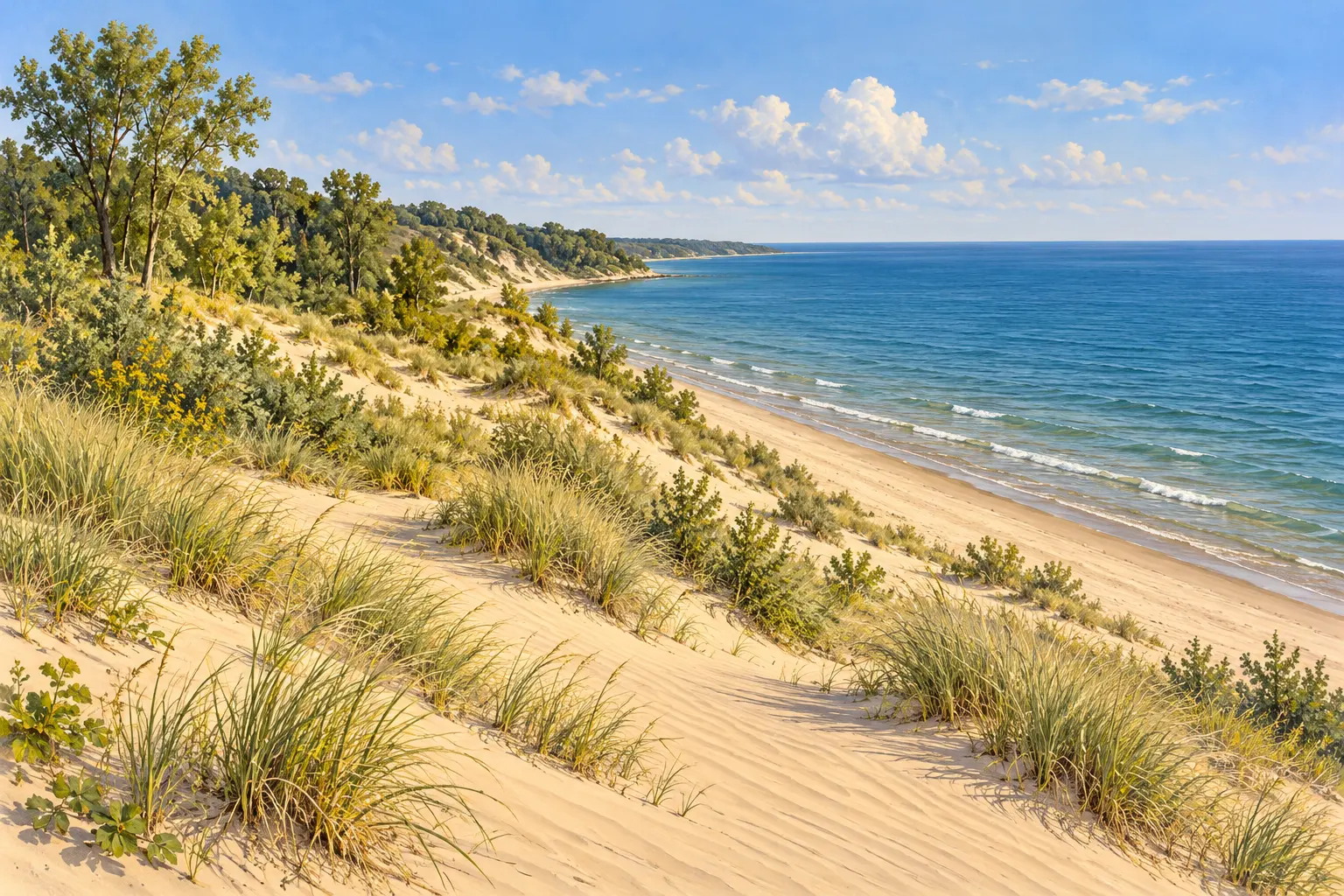
In the 1890s, botanist Henry Chandler Cowles studied the different plant communities growing across Indiana's Lake Michigan dunes. Bare sand and beach grasses near the water gave way to different vegetation on older, more stable ground inland. Comparing these places helped him explain ecological succession: communities change as plants alter the conditions around them. His influential work appeared in 1899. The dunes became a natural laboratory where walking across a landscape offered clues to changes unfolding over much longer periods.
3. One Indiana town hosted two very different utopias
George Rapp's German religious community established New Harmony in 1814, building a productive town around shared work and preparation for Christ's return. In 1825, the Harmonists sold it to Scottish industrialist Robert Owen. With geologist William Maclure, Owen pursued a different experiment centered on education and social equality. That communal project dissolved by 1827, but scientists and educators continued working there. The same streets thus housed successive attempts to redesign society on markedly different foundations.
4. The Walker Building combined business with space for a Black community
Madam C. J. Walker moved her hair-care enterprise to Indianapolis in 1910. The landmark Walker Building, completed in 1927 after her death, went far beyond factory and office space. It contained a theater, beauty shop, drugstore, ballroom, and other businesses; Black professionals who faced barriers to renting elsewhere also found offices there. Her daughter helped carry the project forward. The building joined entrepreneurship with cultural and social infrastructure in a city where segregation restricted both opportunity and recreation.
5. Glassmaking helped consume an enormous Indiana dune
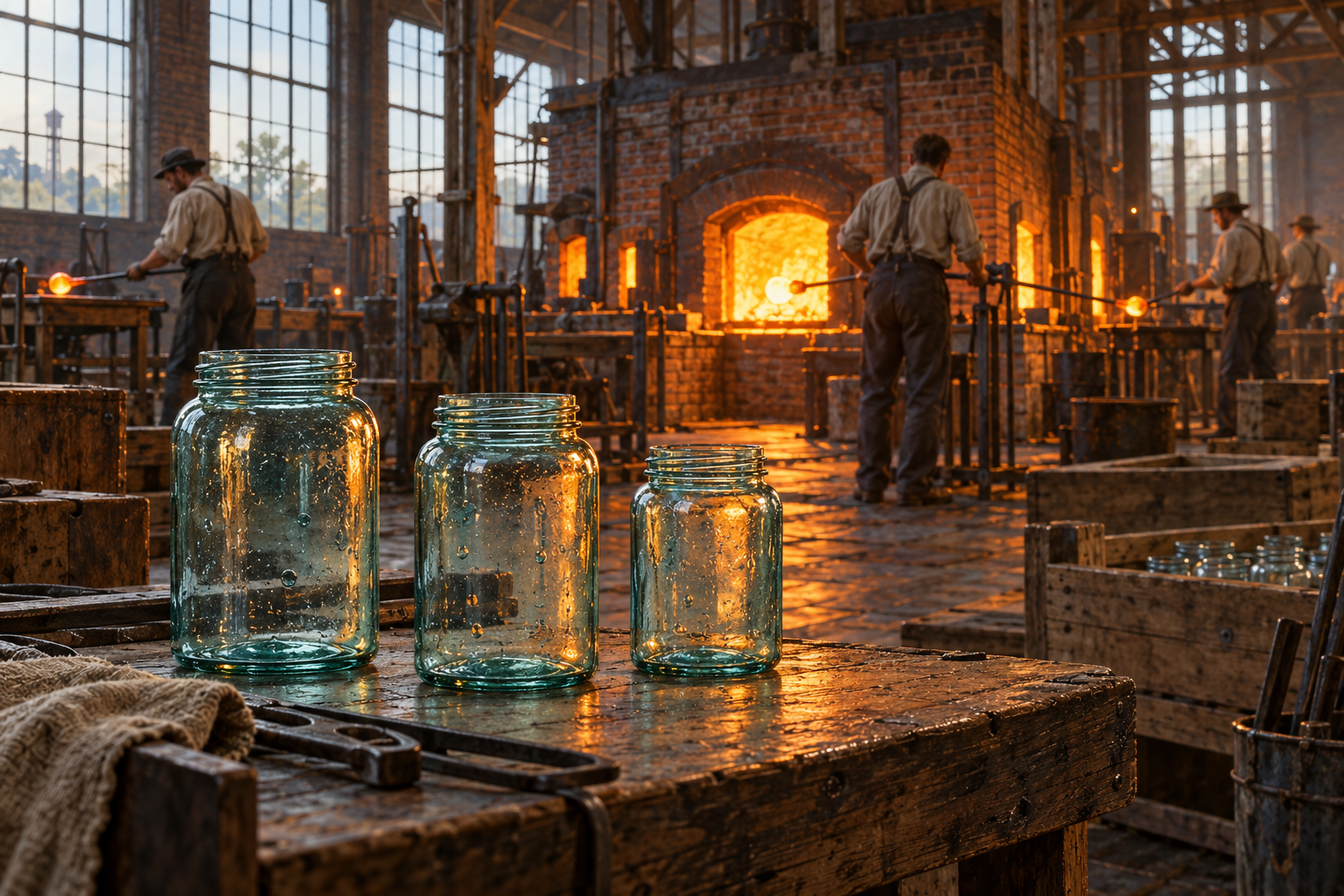
Hoosier Slide once rose about 200 feet above Indiana's lakeshore. It disappeared as sand was hauled away in railroad cars for glass production, including work by the Ball brothers and Pittsburgh Plate Glass. The Ball family had moved its glass business from Buffalo to Muncie in 1887, drawn by the region's natural-gas boom. Their familiar preserving jars therefore connect two Indiana landscapes: the industrial city that supplied fuel and the lakeshore where glassmakers obtained sand at a heavy environmental cost.
6. Crawfordsville built a jail that turned its cells
The Montgomery County jail, built in 1882, placed 16 wedge-shaped cells on a two-story turntable around a central shaft. A hand crank and gearing rotated the cell block inside fixed outer bars. Each cell became accessible only when it lined up with a doorway, allowing a jailer to control access from one position. The mechanism was eventually immobilized because it endangered prisoners. A design intended to improve security had created new hazards through the movement of the building itself.
 You might also like
The Secret Leviathan: 15 Fascinating Facts About the Manhattan Project
7. An ancient Indiana sea supplied the Empire State Building's stone
The building stone known commercially as Indiana limestone is the Salem Limestone, formed from sediments deposited roughly 340 million years ago. Quarries in a narrow belt of south-central Indiana supplied stone used in the Empire State Building, Washington National Cathedral, and the Pentagon. Its fossil fragments and tiny shells record a warm, shallow marine environment. A material chosen for its even texture and thick beds carried pieces of an ancient seabed into some of America's most recognizable architecture.
8. A purification problem linked Indianapolis to insulin's early expansion
After insulin's discovery at the University of Toronto, making a reliable supply became a major challenge. Indianapolis-based Eli Lilly joined the effort in 1922. Company chemist George Walden found that controlling acidity could make insulin separate from pancreatic extracts in a much purer form. Toronto and other researchers were also developing production methods, and patent pooling helped share improvements. The Indiana contribution lay in turning a difficult laboratory extract into a product that could be manufactured more consistently and at greater scale.
9. The real Hoosiers champions already had a strong record
Milan High School's 1954 state basketball title inspired the film Hoosiers, but the real team was more experienced than the fictional Hickory underdogs. Milan had reached the previous year's state semifinals and entered its championship tournament with a 19–2 record. Its school enrolled just 161 students. Bobby Plump's late shot secured a 32–30 victory over much larger Muncie Central. The achievement was remarkable without the movie's invented coach, altered year, or fictional personal dramas.
10. Indianapolis's monumental LOVE began with small Christmas greetings
Robert Indiana experimented with his stacked LOVE design in 1964, sending versions to friends as Christmas cards. The Museum of Modern Art's 1965 card helped spread the image widely. Small sculptures followed, and his first monumental steel version made its public debut at the Indianapolis Museum of Art in 1970. The museum acquired it in 1975. Its tilted O, familiar from the cards, survived the shift from paper to a steel sculpture 12 feet high.
11. Lost River sometimes travels beneath its own landscape
In southern Indiana's limestone country, streams can vanish into swallow holes and continue through underground passages. The Lost River area is a prominent example: dry surface channels may carry water again when rainfall exceeds the underground system's capacity. Nearby Orangeville Rise brings a large tributary back into daylight through a cave opening in a rock-walled basin. Despite its name, that spring is on a tributary, not the main Lost River. The drainage network is much larger than the channels visible above ground.
12. Studebaker's road to automobiles passed through wagons—and electric cars
Henry and Clement Studebaker opened their South Bend blacksmith shop in 1852, beginning the business that became famous for horse-drawn vehicles and later automobiles. Its first electric car was sold in 1902. The transition was gradual: the company continued making horse-drawn vehicles until 1920, long after entering the automobile market. South Bend's industrial story therefore spans overlapping forms of transport, rather than a single clean switch from horses to gasoline engines.
13. The Falls of the Ohio expose a tropical seabed
At Clarksville, the Ohio River reveals fossil beds dating to roughly 390 million years ago, when the area lay beneath a warm tropical sea. Corals, shelled animals, and trilobites left remains in the rock, and more than 600 fossil species have been described from the site. The same hard limestone later created rapids and low-water obstacles for river traffic. These beds connect two very different histories: Devonian marine life and the navigation problems of much later travelers.
14. A town named Santa Claus inspired a summer attraction
Industrialist Louis J. Koch disliked the thought of children visiting Santa Claus, Indiana, and finding no Santa. His answer was Santa Claus Land, which opened on August 3, 1946, with toys, food, children's attractions, and Santa himself. Christmas supplied the organizing theme even for a warm-weather outing. In 1984, the park added Halloween and Fourth of July sections and changed its name to Holiday World. A town's unusual name had become the starting point for a growing family business.
15. Nobody has established one certain origin for 'Hoosier'
Indiana's best-known nickname was already circulating in the early 1830s, when John Finley's poem The Hoosier's Nest helped popularize it. Its origin remains uncertain. Stories have linked it to a greeting resembling 'Who's here?', rough backwoodsmen, or a canal contractor's workers. Poet James Whitcomb Riley even offered a joke about someone finding an ear after a fight and asking 'Whose ear?' These tales belong to the nickname's folklore; their popularity does not establish which, if any, actually produced the word.
How did these facts land?
Know someone who'd love these facts? Share them 👇