15 Surprising Facts About Maryland
A fleet of wooden steamships became wildlife habitat, a refugee created a famous seasoning, and a tiny patch of sky revealed thousands of galaxies.
1. A wooden 'Ghost Fleet' became a habitat for wildlife
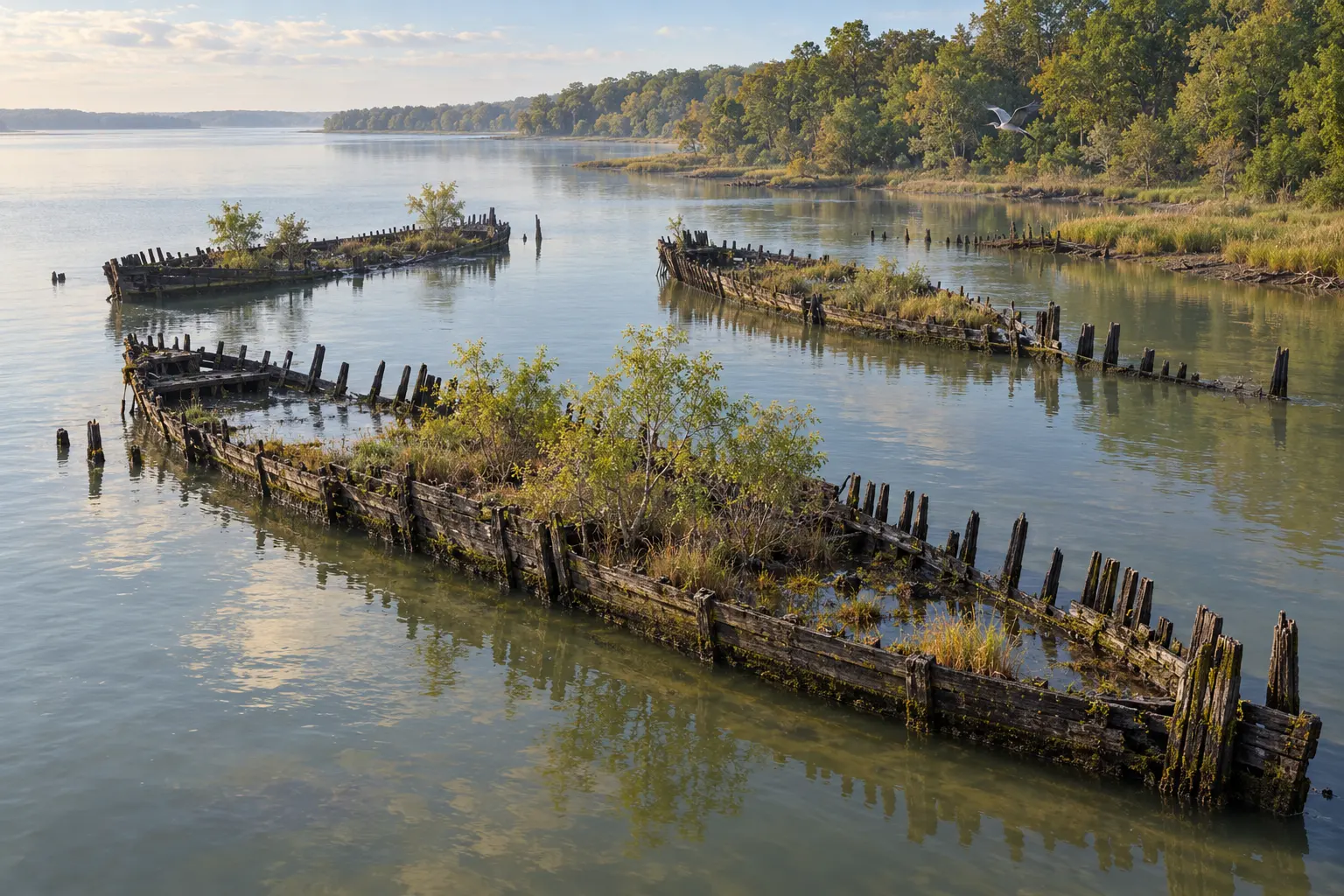
Mallows Bay holds the remains of wooden steamships built for America's World War I shipping effort. The war ended before these ships reached its theater of operations; some later carried cargo on other routes. When the wooden fleet became commercially unattractive, salvagers removed valuable machinery and burned hulls to recover metal. Their remains gradually became part of the Potomac landscape. NOAA describes overgrown wrecks that now provide habitat for fish, beavers, and birds, turning an industrial disposal site into a meeting point of maritime history and ecology.
2. The Star-Spangled Banner was so large it needed a brewery floor
In 1813, Baltimore flagmaker Mary Pickersgill received an order for two flags for Fort McHenry. The larger measured thirty by forty-two feet, overwhelming the space available in her home. Pickersgill and her helpers used a nearby brewery to assemble it. The team included her daughter, two nieces, and Grace Wisher, a young free Black indentured servant. Made with wool bunting and cotton stars, the giant flag had fifteen stars and fifteen stripes. It became the flag associated with Francis Scott Key's account of the fort in 1814.
3. Assateague's horses live on both sides of a state-line fence
Assateague's free-roaming horses share an island that crosses the Maryland–Virginia boundary. A fence separates two main herds with different management: the National Park Service oversees Maryland's horses, while the Chincoteague Volunteer Fire Company owns Virginia's herd. The famous pony swim belongs to the Virginia side. These animals descend from domestic horses and live in smaller social bands, dealing with insects, storms, and limited forage. Spending time on the beach helps them escape the marsh's biting flies and mosquitoes, making the shoreline part of their daily survival strategy.
4. Old Bay's creator rebuilt his life after fleeing Nazi Germany
Gustav Brunn was an experienced Jewish spice merchant before persecution forced his family to flee Germany. After imprisonment at Buchenwald and his release in 1938, he reached Baltimore and began rebuilding his trade. His Baltimore Spice Company stood near the city's wholesale fish market, where seafood sellers bought ingredients for their own blends. Brunn developed the seasoning that became Old Bay, named after a Chesapeake steamship line. The family business later employed other newcomers, giving the familiar regional flavor a history rooted in refuge, work, and resettlement.
5. Bakers' memories helped document the history of Smith Island cake
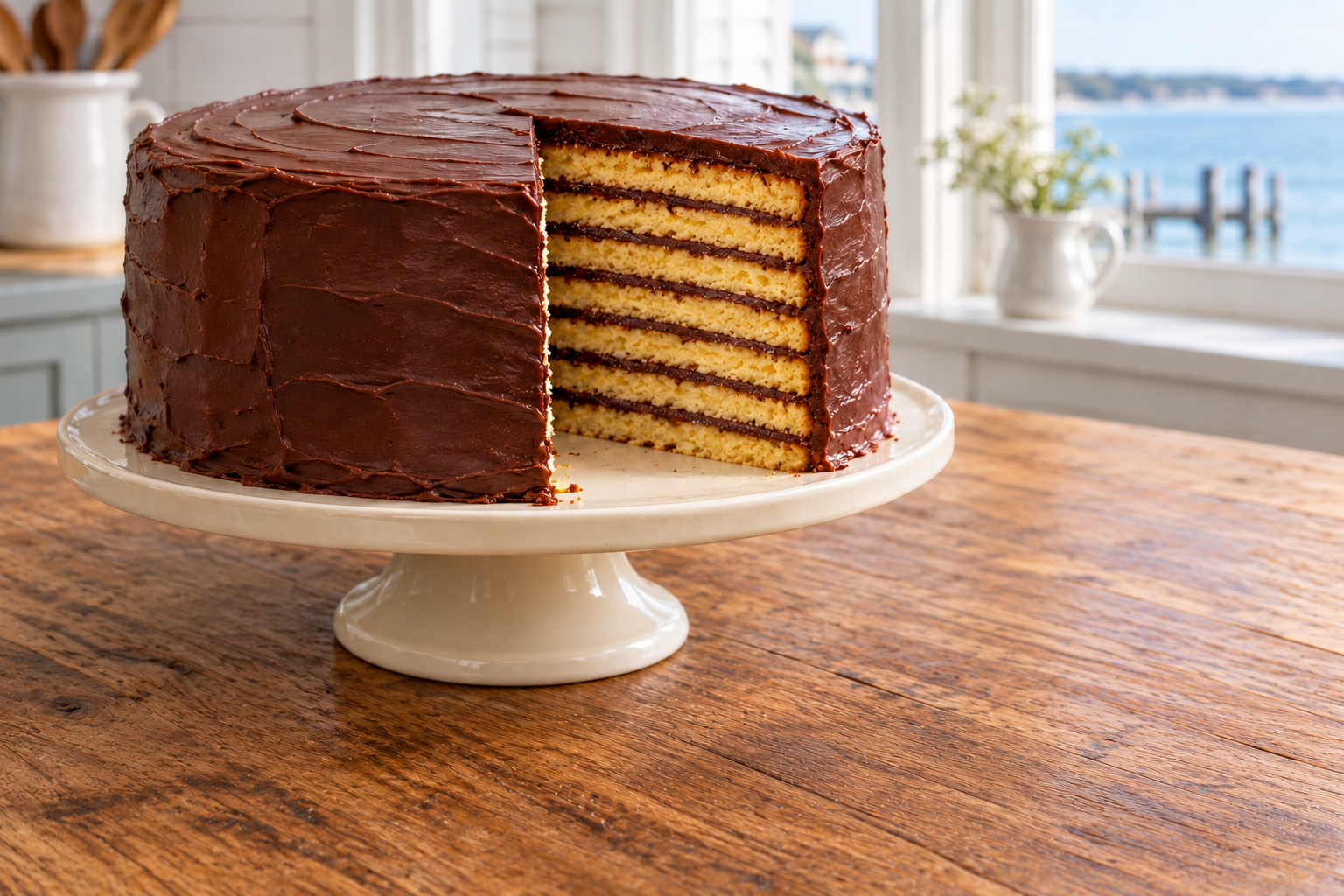
Smith Island cake stacks thin layers of yellow cake with chocolate icing, often eight to ten layers high. It became Maryland's official dessert in 2008. Yet when islanders sought a food-history marker, a lack of early written documentation initially blocked the application. Handwritten letters from bakers Mary Ada Marshall and Janice Marshall described making the cakes with their mothers and grandmothers. Those memories helped establish the tradition's age and secure approval for the marker, showing how family knowledge can supply evidence missing from published cookbooks.
6. Maryland's official jousting sport targets tiny rings
Maryland adopted jousting as its official sport in 1962, but its tournaments reward precision rather than knocking an armored opponent from a saddle. Riders gallop down a course and use a fine-tipped lance to collect suspended rings. The targets shrink as competitors advance in skill; some are only a quarter of an inch across. Men, women, and children compete in classes based on ability, with traditions often passing through families. Maryland later designated lacrosse as its official team sport, adding that separate distinction in 2004.
 You might also like
The Unstoppable MVP: 15 Fascinating Facts About Kevin Durant
7. An astronomer sent Jefferson an almanac and a challenge about slavery
On August 19, 1791, Benjamin Banneker wrote from Baltimore County to Thomas Jefferson, enclosing a handwritten copy of his astronomical almanac for the coming year. The letter also confronted Jefferson with the Declaration of Independence's promise of human equality. Banneker described his own freedom while condemning the captivity imposed on other Black people. His scientific work and moral argument traveled together. The surviving correspondence records a Maryland farmer and self-taught astronomer addressing a powerful slaveholder through both calculation and a direct appeal to his stated principles.
8. Peace had to wait for enough delegates to reach Annapolis
Congress ratified the Treaty of Paris in Maryland's State House on January 14, 1784, but assembling enough representatives had been a problem. Delegates from nine states were needed, and Congress worried about meeting the deadline for returning the document across the Atlantic. Richard Beresford's arrival from South Carolina helped supply the required quorum. The vote took place in the Old Senate Chamber, where George Washington had resigned his military commission only weeks earlier. For a short period, Annapolis stood at the center of the new country's public business.
9. Ancient snail shells yielded delicate organic sheets
Calvert Cliffs fossils can preserve more than an animal's shape. In a 2015 study, researchers examined reddish-brown Ecphora snail shells from Miocene deposits and reported preserved protein-rich material associated with their color. Dissolving the mineral shell left thin, flexible organic sheets, some reaching about a centimeter across. Chemical tests detected peptide bonds and eleven amino-acid residues. The study explored how mineral-bound organic material could survive over millions of years, opening a different way to investigate the animals that once lived in this shallow marine environment.
10. A Baltimore-led project found thousands of galaxies in an apparently empty sky
Robert Williams, director of Baltimore's Space Telescope Science Institute, used some of his discretionary Hubble observing time for a bold experiment. His team selected a relatively empty-looking patch near the Big Dipper and collected exposures over ten days in December 1995. Combining 342 images produced the Hubble Deep Field, revealing roughly three thousand distant galaxies. Choosing a field without bright foreground objects made it possible to see far fainter ones. The observations were made available to researchers worldwide, turning one tiny patch of sky into a major shared scientific resource.
11. Antietam's aftermath reached viewers through three-dimensional photographs
Alexander Gardner and assistant James Gibson photographed Antietam shortly after the September 1862 battle. Many of the images were stereographs: paired photographs that create an impression of depth when viewed through a special device. Their work brought the battlefield's human cost to distant audiences through exhibitions at Mathew Brady's gallery and through woodcut reproductions in newspapers. It was a striking encounter between a popular home-viewing technology and the consequences of war. Gardner returned in October to photograph President Lincoln's visit, adding another layer to the battlefield's visual record.
12. The 1649 Toleration Act combined protection with severe religious limits
Maryland's 1649 Act Concerning Religion is a landmark in the uneven development of religious liberty. It protected worship for people professing belief in Jesus Christ and sought to restrain religious insults. But the same statute prescribed death and forfeiture of property for denying the Trinity or Christ's divinity. Reading its opening provisions alongside its protections reveals how narrow colonial toleration could be. The law emerged amid struggles between Catholics and Protestants, offering an important historical step whose boundaries were very different from modern freedom of religion.
13. The state flag's colors acquired opposing Civil War meanings
Maryland's quartered flag combines the black-and-gold Calvert arms with the red-and-white Crossland arms, designs rooted in the colonial proprietors' family heraldry. During the Civil War, Unionist Marylanders used the Calvert colors, while Confederate Marylanders adopted the Crossland colors and cross. The combined banner gained prominence after the war and became the official state flag in 1904. It is often interpreted as a symbol of reconciliation. A State Archives discussion cautions, however, that the design's uncertain origins leave its initial purpose unresolved.
14. A curved stone railway bridge used wedge-shaped piers
The Thomas Viaduct opened in 1835 to carry the Baltimore and Ohio Railroad across the Patapsco River valley. Its route required a curve, making the arrangement of eight stone arches more complicated than a straight crossing. Engineer Benjamin Henry Latrobe Jr. solved the problem with piers wider on the outside of the curve than on the inside, aligning their sides radially. Skeptics nicknamed the project 'Latrobe's Folly.' The completed granite structure demonstrated the design's strength, including by surviving a major Patapsco flood in 1866.
15. A coin and broken dishes helped locate Harriet Tubman's father's home
Archaeologists searching Blackwater National Wildlife Refuge used historical records and extensive test digging to locate Ben Ross's homeplace. An 1808 coin, nineteenth-century ceramics, bricks, glass, and nails helped build the case announced in 2021. Ross, Harriet Tubman's father, worked as a timber foreman, and Tubman spent part of her youth working alongside him in this wetland landscape. The discovery connected her family's history to physical evidence. Archaeologists later created a virtual museum to share artifacts from a site that rising water makes difficult to study.
How did these facts land?
Know someone who'd love these facts? Share them 👇