The American Colossus: 15 Fascinating Facts About the Super Bowl
While the Super Bowl is widely dismissed by skeptics as merely an excuse to gorge on high-calorie snacks and critique million-dollar television commercials, this monumental event is actually a complex logistical, economic, and cultural colossus that has profoundly shaped American entertainment. Far from being a centuries-old tradition, the championship game was born from a fierce, mid-twentieth-century corporate rivalry that forced a historic merger between the National Football League and the upstart American Football League. Beyond the dazzling halftime shows and the sheer athletic prowess on the field, the Super Bowl serves as a fascinating lens through which we can examine broadcast technology innovations, massive infrastructural undertakings, and staggering consumer behaviors. In this exploration, we will strip away the popular mythology of the big game to reveal fifteen obscure, surprising, and historically fascinating truths that power the biggest Sunday in American sports.
1. The Bouncy Toy Origin
Despite its grandiose and imposing title, the name of the championship game was actually inspired by a children's toy rather than a marketing committee. Lamar Hunt, the founder of the American Football League and owner of the Kansas City Chiefs, coined the term during planning meetings in the mid-1960s after watching his children play with a high-bouncing rubber ball called a Super Ball. Initially, the term was only used as an unofficial placeholder for the cumbersome AFL-NFL World Championship Game, but the media quickly adopted the catchy moniker. It was not officially recognized by the league until the fourth championship game in 1970, forever cementing a whimsical origin into American sporting lore.
2. The Erased Inaugural Broadcast
You might assume that the very first Super Bowl in 1967 is preserved in pristine archives, but the original broadcast was actually wiped from existence by the networks. Both CBS and NBC broadcast the inaugural game, but because television tape was incredibly expensive at the time, both networks recorded over the tapes for daytime soap operas and news broadcasts. It took decades of painstaking archival work by NFL Films to piece together a complete video of the game, relying on hundreds of individual reels of film submitted by fans, news crews, and independent photographers. Even today, a complete, original continuous broadcast tape from either network remains one of the ultimate holy grails of lost television media.
3. The Tiffany Silversmith Tradition
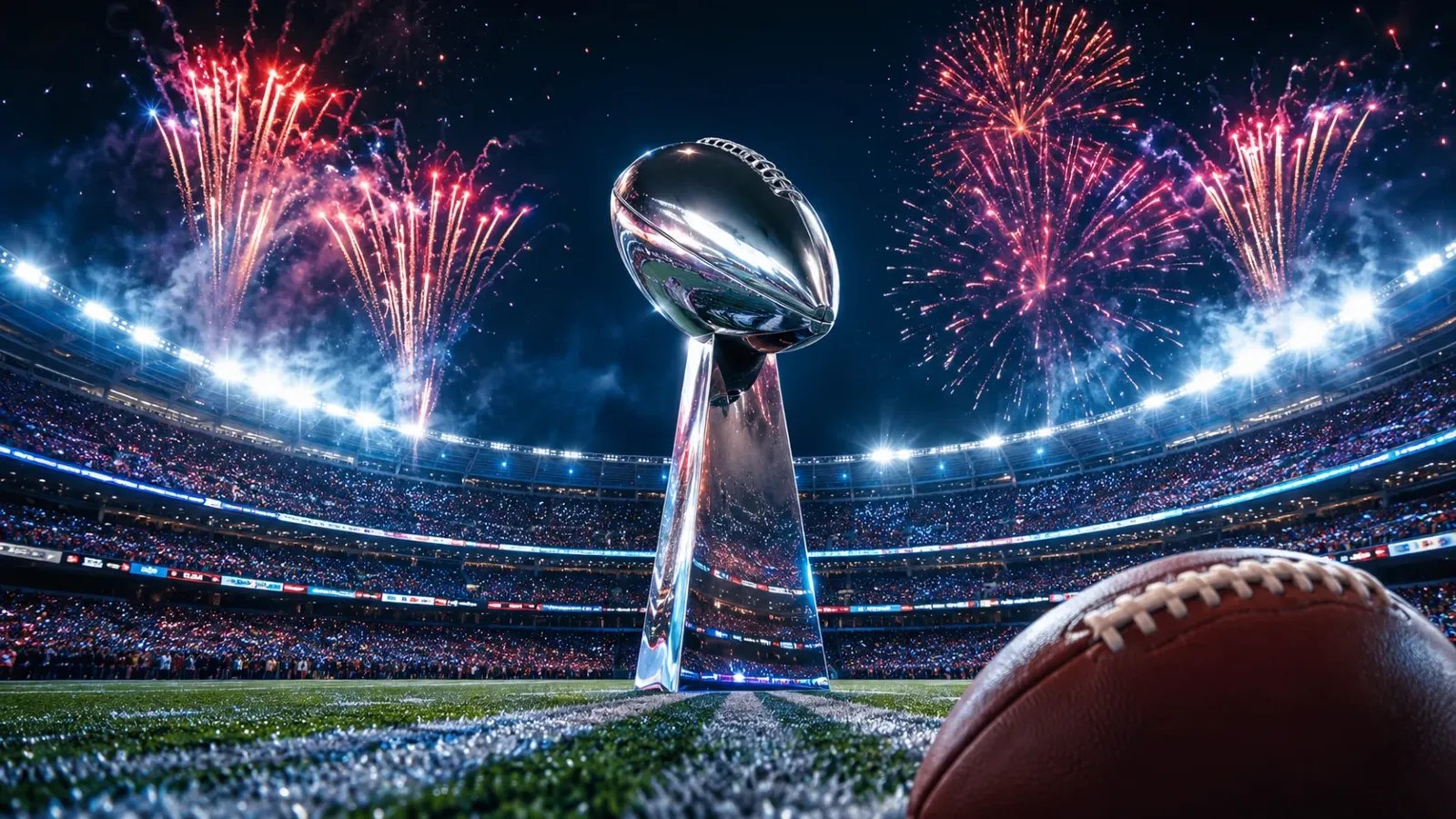
The Vince Lombardi Trophy is widely recognized as the pinnacle of football achievement, yet few realize it is a masterpiece of high-end jewelry craftsmanship rather than a mass-produced sports cup. Since the very first championship, the trophy has been handcrafted in a silversmithing workshop by the luxury brand Tiffany & Co., initially in Newark, New Jersey, and now in Cumberland, Rhode Island. It takes skilled artisans approximately four months to forge, spin, and polish the seven-pound sterling silver prize, using techniques that date back to the nineteenth century. Unlike the NHL's Stanley Cup, which is passed from winner to winner, a new Lombardi trophy is forged every year, allowing the victorious franchise to keep their hard-won masterpiece permanently.
4. The Flawed Market Indicator
For decades, financial analysts have half-jokingly tracked the Super Bowl Indicator, a bizarre economic theory suggesting the stock market's year-end performance can be predicted by the game's winner. The theory posits that if a team from the original National Football League wins, the stock market will end the year higher, whereas an original American Football League team victory forecasts a bear market. While this correlation boasted a staggering ninety percent accuracy rate throughout the late twentieth century, economists are quick to debunk it as a classic example of data dredging and spurious correlation. The myth persists in financial circles primarily as a lesson in the dangers of confusing correlation with causation, proving that human brains will find patterns even in entirely unrelated events.
5. The Marching Band Era
Modern halftime shows are synonymous with multi-million-dollar pop music extravaganzas, leading many to believe the game has always been a platform for chart-topping superstars. In reality, the NFL utilized college marching bands, drill teams, and the wholesome musical youth group Up with People to entertain audiences for the first two and a half decades of the event. It was not until the early 1990s, when the Fox network successfully counter-programmed a live episode of the comedy show In Living Color during the halftime break, that the NFL realized they were losing millions of viewers. To combat this audience attrition, the league hired Michael Jackson to perform at Super Bowl XXVII in 1993, permanently transforming the halftime show from a collegiate musical interlude into a global pop-culture phenomenon.
6. The K-Ball Protocol
The footballs used during the championship game are subjected to an obsessive level of logistical security, particularly those designated for the kicking game. To prevent teams from aggressively breaking in, scuffing, or tampering with the footballs used for punts and field goals, the league introduced special K-Balls in the late 1990s. These specific footballs are shipped directly from the Wilson factory in Ohio straight to the officials' hotel, where they remain under strict lock and key until shortly before kickoff. Because these balls are practically brand new and lack the worn-in texture of standard offensive footballs, kickers often find them slick and difficult to strike, adding a hidden layer of physical challenge to every championship field goal.
7. A National Security Fortress
The logistical undertaking to protect the host stadium elevates the game far beyond a standard sporting event, treating it essentially as a matter of national security. The Department of Homeland Security designates the Super Bowl as a Special Event Assessment Rating 1 event, the highest possible security threat level in the United States, sharing this classification with the State of the Union address. This designation triggers a massive, coordinated mobilization of federal agencies, including the FBI, Secret Service, and FEMA, who establish physical perimeters, monitor airspace, and deploy advanced radiation detection equipment. The sheer scale of this invisible security apparatus costs millions of dollars and operates entirely out of sight, ensuring the safety of the attendees while the nation focuses solely on the gridiron.
8. The Phantom Flush Effect
A persistent urban legend claims that municipal water systems across the United States experience devastating pressure drops during halftime because millions of Americans simultaneously flush their toilets. While engineers do see a noticeable spike in water usage during the commercial breaks and halftime, modern infrastructure is more than capable of handling these synchronized bathroom breaks without catastrophic failure. The myth originated in the 1980s when a single broken water main in Salt Lake City coincidentally ruptured during the game, leading local news to erroneously blame the localized flood on Super Bowl viewers. Today, water treatment operators do monitor the game to adjust pump pressures slightly, but the dreaded catastrophic super flush remains a thoroughly debunked myth of civil engineering.
9. The Imperial Numerology
The NFL's insistence on using Roman numerals to designate each Super Bowl seems like an attempt to inject ancient grandeur into a modern sport, but it was actually a practical solution to a scheduling headache. Because the NFL season stretches across two calendar years—beginning in the autumn and concluding in the winter of the following year—simply using the year of the game caused mass confusion among historians and fans. Lamar Hunt introduced the Roman numeral system starting with Super Bowl V to create a unique, sequential identifier that would permanently separate the championship game from the specific calendar year it was played in. The league only abandoned this tradition once, utilizing Arabic numerals for Super Bowl 50 because graphic designers found the solitary letter L visually unappealing for the golden anniversary logo.
10. The Guaranteed Loser's Purse
While the glory of victory and the accompanying championship rings are the ultimate prize, the financial structure of the game ensures that even the losing athletes receive a substantial economic windfall. Unlike typical corporate bonuses tied exclusively to success, the NFL's collective bargaining agreement mandates a guaranteed payout to every player on the losing team's roster. In recent years, this loser's share has climbed to nearly ninety thousand dollars per player, a sum that eclipses the median annual income of the average American household. This financial safety net highlights the immense revenue generated by the television broadcast rights, ensuring that simply participating in the championship game is highly lucrative regardless of the final score.
11. The Avocadian Logistics
The culinary consumption associated with the game is staggering, but the massive influx of avocados required for game-day guacamole involves an extraordinary international supply chain maneuver. The United States consumes over one hundred million pounds of avocados during the championship weekend, the vast majority of which must be imported from the Michoacan region of Mexico in a matter of weeks. To meet this immense, concentrated demand, agricultural conglomerates coordinate thousands of temperature-controlled freight trucks to cross the border in a meticulously timed procession, racing against the fruit's rapid ripening process. This phenomenal logistical ballet demonstrates how a single American sporting event dictates international agricultural harvest schedules and cross-border trade dynamics.
12. The Custom Cultivated Turf
The vibrant green grass upon which the game is played is rarely the native turf of the host stadium, but rather a bespoke agricultural product grown specifically for the championship. The NFL frequently contracts specialty turf farms years in advance to cultivate custom hybrid grass blends designed to withstand the exact climate of the host city and the intense physical trauma of the game. This grass is often grown entirely off-site on immense plastic sheets so that the root systems intertwine into a solid, movable mat, which is then transported in refrigerated trucks to the stadium weeks before kickoff. This obsessive agronomic engineering ensures that the playing surface looks flawless on high-definition television and performs uniformly, regardless of the harsh weather conditions outside the stadium.
13. The League's Jewelry Subsidy
Championship rings are famous for their ostentatious displays of diamonds and team logos, but the league maintains strict financial oversight regarding their creation. The NFL contributes a set allowance—historically around five to seven thousand dollars per ring for up to one hundred and fifty rings—to the winning franchise to offset the immense cost of the jewelry. However, because modern team owners constantly attempt to outshine previous champions with increasingly massive and diamond-encrusted designs, the actual cost of a single ring frequently exceeds forty thousand dollars. The victorious team's ownership must cover the massive remaining balance out of pocket, turning the ring ceremony into a subtle financial flex of the owner's personal wealth.
14. The Missing Shutout
Given the violent and unpredictable nature of professional football, one might assume that at least one championship game resulted in a team failing to score a single point. Surprisingly, across more than half a century of Super Bowl history, no team has ever been completely shut out on the grandest stage. The Miami Dolphins came the closest during Super Bowl VI in 1972 when they managed only a single field goal against the Dallas Cowboys, ending the game with a meager three points. This statistical anomaly speaks to the intense parity of the league and the offensive firepower required to simply reach the championship, ensuring that even the most lopsided defeats feature at least minor scoring successes.
15. The Rigorous Coin Toss Customization
The coin toss that initiates the game is far from a standard quarter pulled from a referee's pocket; it is a highly specialized piece of numismatic art. The Highland Mint, a specialized foundry in Florida, is tasked with crafting a unique, oversized silver or gold-plated coin for each championship, featuring the specific matchup's logos and date. Only a handful of these exact coins are minted for the game, with one designated for the actual toss and the others sent to the Pro Football Hall of Fame or reserved as VIP gifts. The sheer weight and size of this custom coin drastically alters its aerodynamic properties, forcing referees to practice their flipping technique in the weeks leading up to the game to ensure a fair and highly visible rotation on television.
Sources & References
This AI-assisted post was rigorously curated and fact-checked for accuracy by:
 Martin Roháček
How fun was this article? 🤔
Tap a star to rate it
🧠 Quiz: How closely were you paying attention?
10 questions — all answers are in the article above!
Enjoyed these facts? There's more! 💌
Fresh fun facts in your inbox. No spam, ever.