The Unofficial Ceasefire: 15 Fascinating Facts About the Christmas Truce of 1914
The 1914 Christmas Truce is often romanticized as a uniform, magical pause where all soldiers played football. In reality, this unsanctioned ceasefire was a highly localized, bizarrely pragmatic event that authorities desperately tried to suppress. Discover the obscure historical truths, fraternization penalties, and chilling aftermath of history’s most misunderstood display of wartime humanity.
1. The Christmas Truce was not a universal ceasefire across the entire Western Front.
While popular legend suggests the guns fell silent everywhere, the truce was actually highly sporadic and localized. In some sectors, soldiers exchanged gifts and sang carols, but in others, bitter fighting continued without pause. Dozens of men were killed on Christmas Day in 1914 by enemy forces who refused to participate in any fraternization. The decision to stop fighting rested entirely on local commanders and the disposition of the specific units facing each other across No Man's Land.
2. German soldiers initiated the truce by placing illuminated Christmas trees on their trench parapets.
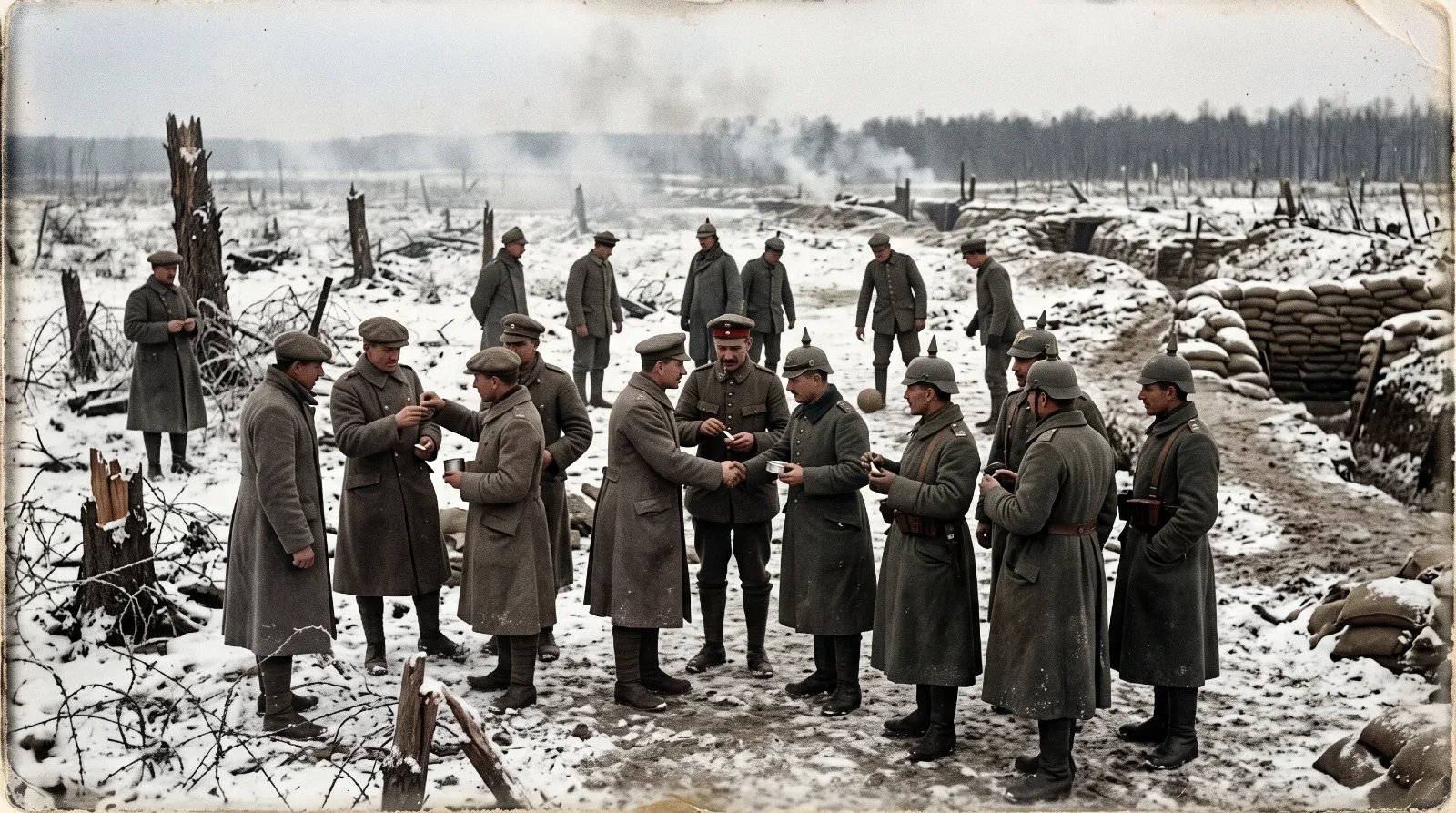
The initial spark for the ceasefire came from the German lines on Christmas Eve, where troops began observing the holiday according to their national customs. German soldiers, many of whom had received small fir trees sent by Kaiser Wilhelm II, lit candles and placed them along the edges of their trenches. They then began singing carols like Stille Nacht, prompting British troops to respond with their own holiday songs. This surreal visual and auditory display bridged the deadly gap between the opposing armies and encouraged the first tentative steps into No Man's Land.
3. The famous football matches in No Man's Land were likely exaggerated and mostly consisted of disorganized kickabouts.
The enduring image of a highly organized Britain versus Germany football match is largely a myth born from soldiers' letters and later romanticized by the press. While men did kick makeshift balls often made of rolled-up rags, sandbags, or empty ration tins, these were not structured games with goals and referees. Most historians agree that the matches were chaotic, friendly scrambles involving dozens of men on frozen, crater-filled ground. Furthermore, there is little concrete evidence to support the widely circulated claim that the Germans won a specific match by a score of 3 to 2.
4. A major driving force behind the truce was the desperately needed opportunity to bury the dead.
Although holiday spirit played a role, a grim pragmatism heavily influenced the decision to lay down arms. Weeks of fierce winter fighting had left No Man's Land littered with decomposing bodies that neither side could safely retrieve under normal conditions. The informal ceasefire allowed burial parties from both armies to venture out and inter their fallen comrades, occasionally even holding joint bilingual religious services. Once the traumatic labor of burying the dead was completed, the soldiers naturally began to converse, trade, and share rations.
5. Senior military leaders on both sides were furious and immediately issued orders prohibiting future fraternization.
When news of the spontaneous peace reached the higher echelons of command, generals were terrified that it would undermine military discipline and fighting spirit. British General Sir Horace Smith-Dorrien explicitly ordered that friendly intercourse with the enemy was strictly forbidden, fearing the troops would lose their offensive zeal. The German high command echoed these sentiments, threatening severe punishment, including charges of treason, for anyone caught negotiating local truces. To prevent a recurrence, commanders ensured that future holidays were marked by heavy artillery bombardments and continuous raiding.
6. Millions of mass-produced gift boxes sent by both governments inadvertently fueled the fraternization.
In an effort to boost morale, both the British and German governments organized mass shipments of holiday gifts to the front lines. British troops received the Princess Mary brass tin filled with tobacco and sweets, while German soldiers received the Kaiserliche Schachtel containing cigars and chocolates. Flush with these luxury items, troops on both sides found themselves with an excess of goods that made perfect trading currency. The desire to swap British tobacco for German sausages and souvenirs directly encouraged the opposing forces to meet in the middle.
 You might also like
The Absentee Crusader: 15 Fascinating Facts About Richard the Lionheart
7. Pre-war economic migration meant many German soldiers could speak perfect English to their British counterparts.
Communication during the truce was surprisingly easy due to the large number of German soldiers who had lived and worked in Great Britain before the war broke out. Many Germans had been employed as waiters, barbers, or factory workers in London and other British cities, resulting in a high degree of English fluency. These men acted as informal interpreters, eagerly asking British soldiers for news about specific neighborhoods, restaurants, or English football clubs. This shared pre-war civilian experience highlighted the absurdity of the conflict and helped quickly dismantle enemy demonization.
8. British and German newspapers initially suppressed news of the truce to maintain public support for the war.
For weeks, the press in both nations remained completely silent about the unprecedented fraternization, adhering to strict military censorship guidelines. It was not until late December that the embargo was broken by the New York Times in the neutral United States, which published letters sent home by British soldiers. Facing this leak, British newspapers finally began printing photographs and accounts of the truce by early January 1915, framing it as a testament to the sporting nature of the British soldier. Conversely, German media remained highly restrictive, offering only muted and highly critical coverage of the event.
9. A young Adolf Hitler was present on the Western Front and harshly criticized his fellow soldiers for participating in the truce.
Serving as a corporal in a Bavarian Reserve Infantry Regiment, Adolf Hitler was stationed near the frontline during the Christmas period of 1914. Unlike many of his peers, he refused to participate in the friendly exchanges and remained in his trench, actively berating the men who ventured into No Man's Land. According to historical accounts from his unit, Hitler argued that such behavior should not be allowed during wartime and questioned the honor of the German soldiers involved. His fanatical dedication to the war effort foreshadowed the extremist ideology he would later force upon the world.
10. Isolated instances of holiday fraternization occurred again in 1915 despite strict military prohibitions.
While history books often claim the 1914 truce was a one-time event, smaller and highly clandestine ceasefires did occur during Christmas of 1915. In a few localized sectors, British and German troops once again exchanged shouted greetings and briefly met to trade souvenirs, though on a much smaller scale. However, artillery barrages and swift disciplinary action by vigilant officers quickly extinguished these attempts. By 1916, the massive casualties of battles like the Somme and Verdun had fostered too much bitterness, ensuring that Christmas truces vanished entirely from the Western Front.
11. French and Belgian troops also participated in truces contrary to the belief that it was an exclusively Anglo-German event.
While the British and German interactions are the most heavily documented, French and Belgian soldiers also engaged in localized truces with their German enemies. These instances are less famous because the Germans were occupying French and Belgian soil, making fraternization a highly sensitive and somewhat taboo subject for those nations. Nevertheless, there are recorded accounts of French soldiers exchanging tobacco and sharing wine with German troops in the flooded trenches of Flanders. French authorities censored these events far more rigorously than the British in an attempt to erase the memory of fraternized troops defending their invaded homeland.
12. One German soldier famously set up a makeshift barber shop between the trenches to cut the hair of his enemies.
The surreal nature of the truce allowed pre-war professions to temporarily resume in the most unlikely of places. A German soldier who had worked as a barber in London before the war brought his scissors and clippers out into No Man's Land. He spent Christmas Day giving haircuts to British troops, reportedly charging them a few cigarettes per trim. This bizarre, highly domestic scene perfectly encapsulates how quickly soldiers discarded their military identities when the immediate threat of death was removed.
🤔 Quick guess
Which organized, global plea for peace coincided with the soldiers' spontaneous truce?
13. The truce forced high command to rotate participating units out of the front line to ensure they would fight again.
Following the ceasefire, commanders discovered that troops who had shared food and photos with the enemy were deeply reluctant to resume shooting at them. To restore offensive capability, generals on both sides were forced to cycle the fraternizing units out of the frontline trenches and replace them with fresh troops. These new units, who had not bonded with the men across No Man's Land, were ordered to immediately initiate aggressive sniping and artillery barrages. This calculated administrative maneuver effectively severed the brief human connections forged during the holiday.
14. Similar spontaneous Christmas ceasefires occurred between Austro-Hungarian and Russian troops on the Eastern Front.
The phenomenon of wartime fraternization was not limited to the muddy fields of France and Belgium. During the same period, soldiers on the Eastern Front initiated their own truces, with Austro-Hungarian troops meeting Russian soldiers in the freezing snow. Because the Russian Orthodox Church celebrated Christmas in January, the timing was different, but the core behaviors of exchanging food, singing, and avoiding combat were identical. These Eastern truces were also swiftly crushed by military authorities who feared a complete collapse of discipline across the sprawling border.
15. The soldiers' truce coincided with a massive organized plea for peace by suffragettes and women's rights advocates.
As the men fraternized on the battlefield, the Open Christmas Letter was being circulated globally, spearheaded by British suffragette Emily Hobhouse. Signed by 101 British women and addressed to the women of Germany and Austria, the letter acknowledged the shared grief of the conflict and pleaded for a negotiated peace. While the soldiers' truce was a spontaneous tactical pause, the women's letter was a highly political attempt to end the war entirely. Both efforts ultimately failed to halt the industrial slaughter, but they remain intertwined symbols of resistance against the inevitability of the First World War.
How did these facts land?
Know someone who'd love these facts? Share them 👇
🧠 Quiz: How closely were you paying attention?
Think you remember the facts? 10 questions, tap an answer.