A Borrowed Name and a Lake Full of Fossils: 15 Fascinating Facts About Wyoming
Wyoming's big landscapes hold surprisingly intimate stories: a judge in a mining town, names cut into a trail landmark, and fish preserved in the mud of a vanished lake. Its history connects early votes for women with contested treaties and its geology stretches from ancient rock to active hot springs. Here are fifteen ways to look beyond the familiar cowboy silhouette.
1. Its name traveled west from Pennsylvania
Wyoming takes its name from the Wyoming Valley in northeastern Pennsylvania, with roots in a Delaware, or Lenape, place-name. Congressman James Ashley proposed it for the western territory in the 1860s. Other names considered during the debate included several connected more directly with the region. The label on this famously western state thus carries a geographical history from the other side of the continent.
2. Women gained the territorial vote in 1869
On December 10, 1869, Wyoming Territory enacted legislation granting women voting rights and the right to hold office. It was a landmark in the history of the future U.S. states, more than fifty years before the Nineteenth Amendment. The reasons involved a complicated mixture of advocacy and territorial politics. Calling Wyoming the first place anywhere in the world where any women could vote would erase earlier, different examples.
3. A mining town appointed a pioneering woman judge
Esther Hobart Morris became a justice of the peace in South Pass City in February 1870. Her appointment made women's new public role visible in the everyday business of a mining settlement. Later accounts sometimes turn her into the sole architect of the suffrage law, including a famous tea-party story. Historical research treats that neat origin story cautiously while recognizing the significance of her judicial service.
4. America's first woman governor took office here
Nellie Tayloe Ross won election in 1924 following the death of her husband, Governor William Ross. She took office on January 5, 1925, ahead of Miriam Ferguson in Texas, becoming the first woman to serve as governor of a U.S. state. Ross later directed the United States Mint. Her career links Wyoming's territorial suffrage milestone with a much later breakthrough in executive office.
5. Yellowstone is mostly Wyoming, but crosses two state lines
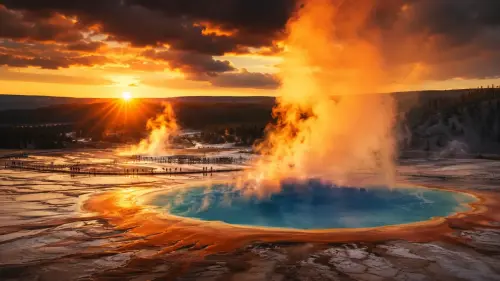
Congress established Yellowstone National Park on March 1, 1872. About 96 percent of its area lies in Wyoming, with smaller portions in Montana and Idaho. Its boundaries follow neither a simple state outline nor just the location of its best-known geysers. That matters when describing the park: Wyoming contains most of this pioneering protected landscape, but does not contain all of it.
6. Its hot-water scenery is an active geological system
Yellowstone contains more than 10,000 hydrothermal features, including hundreds of active geysers, according to the National Park Service. Heat, groundwater and underground plumbing produce a changing landscape of springs, steam vents and eruptions. The volcanic system is monitored, and 'active' does not mean a giant eruption is imminent. The spectacle comes from continuing geological processes rather than a landscape whose story ended in prehistory.
 You might also like
The Evolutionary Speedster: 15 Fascinating Facts About Pronghorns
7. Devils Tower was the first national monument
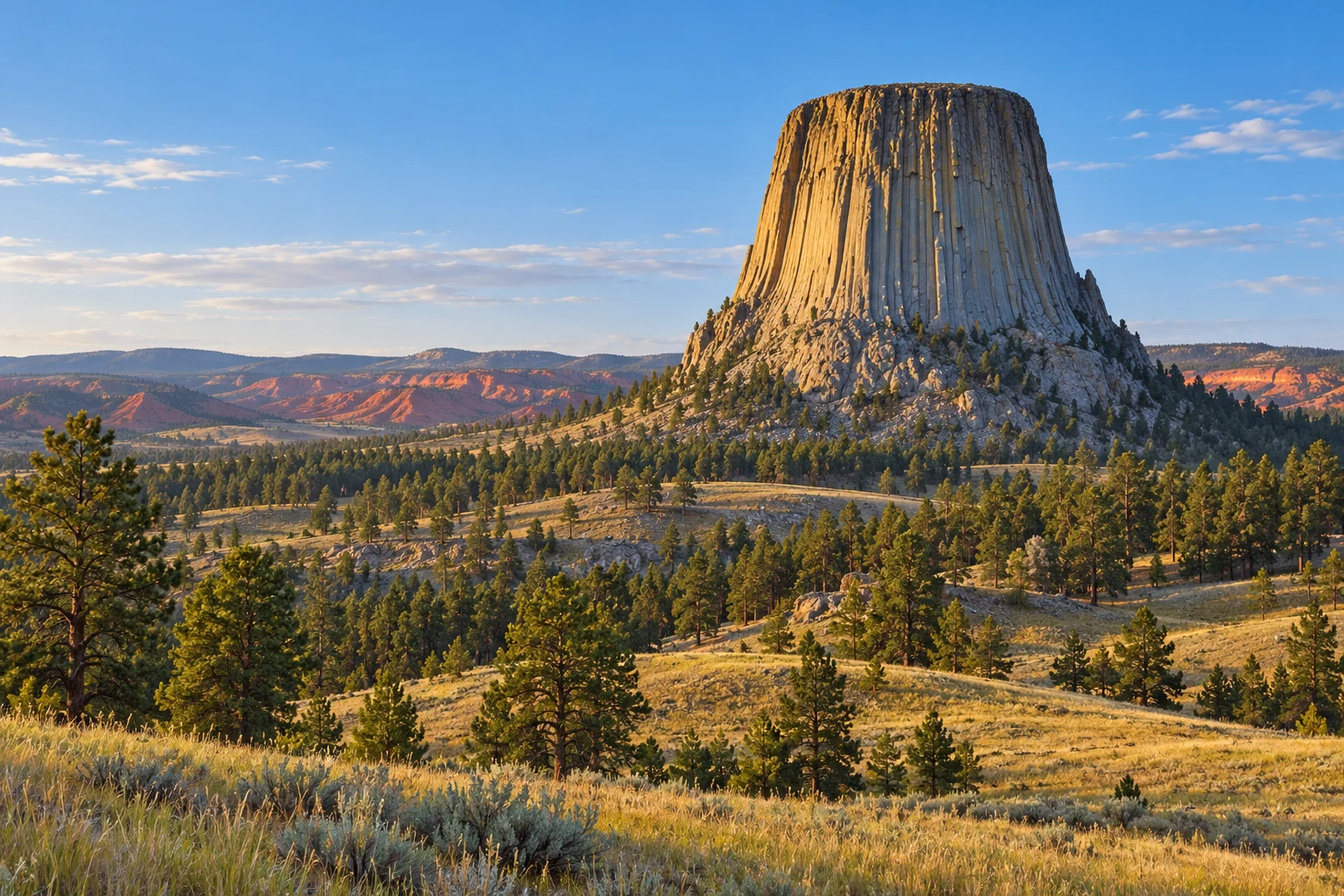
President Theodore Roosevelt proclaimed Devils Tower a national monument on September 24, 1906, the first use of that designation. The formation is also a place of enduring significance for Indigenous nations. Its status therefore encompasses more than a dramatic climbing destination or a familiar movie backdrop. The tower's public history and the much older cultural connections to it belong in the same account.

8. The tower began as molten rock below ground
Devils Tower's columns are made of phonolite porphyry. Geologists agree that molten material entered existing rock underground and later became exposed through erosion, but disagree about details of the original setting and shape. Its present outline is not enough to prove one simple 'extinct volcano' story. The uncertainty makes it a useful example of how scientists can share substantial evidence while continuing to debate an explanation.
9. A vanished lake preserved fish, bats and small horses
About 52 million years ago, a freshwater lake occupied part of southwestern Wyoming. At Fossil Butte, layered deposits preserve creatures from that lake and its surroundings, including fish, crocodilians, bats and small horses. Low oxygen, conditions unfavorable to scavengers and microbial mats helped keep remains together. The fossils reveal a warm, wet ecosystem very different from the dry landscape visitors see above the rock today.
10. South Pass is broad enough to disappoint a mountain romantic
The historic South Pass is a gently rising gap roughly twenty miles wide, rather than a narrow notch between cliffs. That relatively manageable crossing of the Continental Divide made it crucial to overland wagon routes. Native peoples knew and used it long before U.S. emigrants arrived. Its importance came from how un-dramatic it could be: wheeled vehicles could cross a barrier that otherwise made western travel much harder.
11. Independence Rock became a travelers' register
Thousands of emigrants camped beside Independence Rock and left names or messages on its granite. The landmark's surviving inscriptions give individual identities to a migration often described in enormous numbers. They are historical evidence, not an invitation for visitors to add their own. The National Park Service asks people to avoid walking over the oldest markings because those traces of earlier journeys are wearing thin.
12. Fort Laramie started in commerce before becoming a military post
The site's first fort, built in 1834, served the fur and buffalo-robe trade near the meeting of the Laramie and North Platte rivers. Later it became an important stop for emigrants and a U.S. Army post. Those changing uses record changing relationships with Indigenous nations. A building described simply as a 'frontier fort' can conceal a much more complicated history of trade, migration and conflict.
13. A famous treaty was negotiated at Fort Laramie
The 1868 Treaty of Fort Laramie recognized a reservation for the Sioux and addressed other rights and obligations. It stands among the major documents in the history of U.S. relations with Plains nations. Reading the actual text adds substance to a roadside historical marker: it records promises by named parties, not a vague agreement that simply 'opened the West.' Its consequences reach beyond the boundaries of present-day Wyoming.
14. The Tetons combine a rising range with extremely old rock
The Teton Range rises sharply beside Jackson Hole because of movement on the Teton fault. Much of its exposed gneiss is around 2.7 billion years old, while the mountain landscape developed much later. A rock's age and a mountain range's age are different measurements. That distinction lets the scenery tell two stories at once: ancient crust, and the more recent forces that lifted and sculpted it.
15. Yellowstone's bison survived an extraordinary bottleneck
By 1902, poaching had reduced Yellowstone's wild bison to roughly two dozen animals. Protection and managed recovery helped bring them back from that precarious remnant. Their survival is a major conservation story, but also one involving continuing decisions about disease, habitat and movement outside park boundaries. Seeing a herd against Wyoming's landscape is therefore a view of both an old ecological relationship and sustained modern conservation work.
How did these facts land?
Know someone who'd love these facts? Share them 👇