The Colossal Deal: 15 Fascinating Facts About the Louisiana Purchase
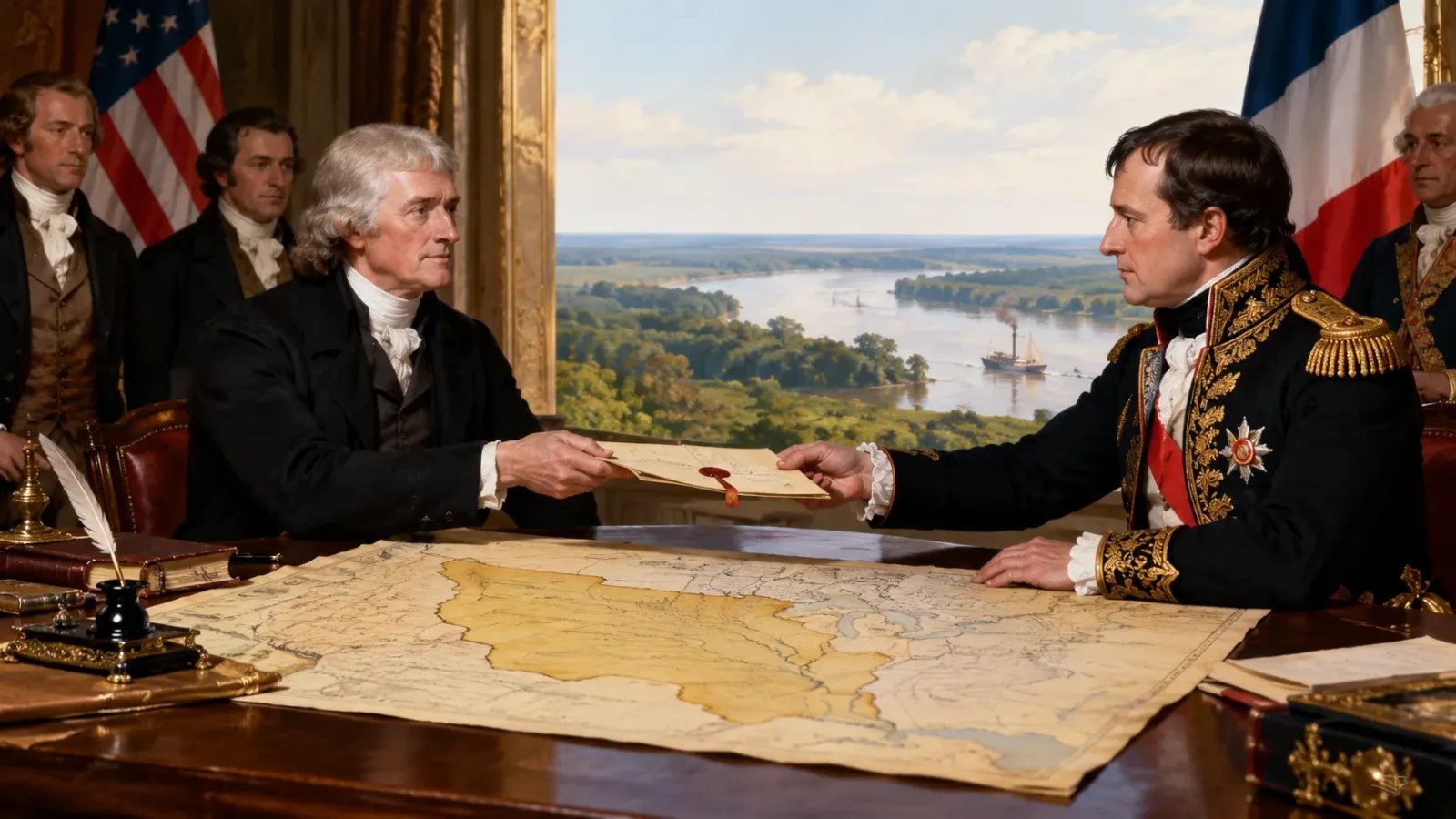
Many assume Thomas Jefferson boldly planned to double the nation's size in 1803, but he originally only wanted to buy New Orleans. The Louisiana Purchase was actually a desperate fire sale by a war-torn Napoleon Bonaparte. Discover the bizarre constitutional crises, secret treaties, and accidental triumphs that made this monumental land deal possible.
1. Thomas Jefferson originally only intended to purchase the city of New Orleans and the surrounding coastal area.
He sent James Monroe to Paris with an offer of up to ten million dollars just for New Orleans and the Floridas. Napoleon's counter-offer of the entire Louisiana territory for fifteen million dollars shocked the American diplomats, who had no constitutional authority to make such a massive, continent-altering purchase but immediately accepted it anyway.
2. A devastating slave revolt in Haiti forced Napoleon Bonaparte to abandon his dream of a North American empire.
The Haitian Revolution, led by brilliant military strategists like Toussaint Louverture, decimated French forces through intense combat and rampant yellow fever. Without the lucrative sugar colony of Saint-Domingue to fund his treasury, Napoleon viewed the massive mainland territory of Louisiana as entirely useless and indefensible, prompting him to liquidate the asset.
3. The United States had to borrow heavily from European banks to afford the fifteen million dollar asking price.
America did not have the cash on hand to buy the territory, so the government financed the deal through two European banks, Baring and Company of London and Hope and Company of Amsterdam. Despite the ongoing military tensions between Britain and France, British bankers enthusiastically funded the American purchase, effectively giving Napoleon the cash he needed to wage war against Britain.
4. The boundaries of the purchased territory were entirely undefined at the time the treaty was signed.
The French deeded the land with the exact same vague phrasing they had received from Spain just three years earlier. When American diplomats asked French Foreign Minister Charles Maurice de Talleyrand for specific borders, he simply told them they had made a noble bargain and would have to make the most of it, leading to decades of armed border disputes with Spain and Britain.
5. Thomas Jefferson believed the Louisiana Purchase was unconstitutional and initially drafted an amendment to legalize it.
As a strict constructionist, Jefferson struggled deeply with the fact that the Constitution did not explicitly grant the president the power to acquire foreign territory. Fearing Napoleon might withdraw the offer while a slow-moving amendment was debated in Congress, Jefferson ultimately swallowed his political principles and justified the acquisition under his executive treaty-making powers.
6. Spain actually controlled the territory for decades leading up to the sale and was furious about the American acquisition.
France had secretly reacquired Louisiana from Spain in 1800 through the Treaty of San Ildefonso, on the strict condition that France would never sell it to a third party. Spain still physically administered the region in 1803 and considered Napoleon's sale to the United States a blatant violation of international law, though the Spanish lacked the military might to stop the transaction.
7. The land acquisition doubled the size of the United States but ignored the citizenship and land rights of the Native Americans living there.
While the treaty promised that the inhabitants of the territory would be incorporated into the Union with all the rights of American citizens, this applied primarily to the French and Spanish colonists in places like New Orleans. The countless Indigenous nations who actually occupied and controlled the vast majority of the land were completely excluded from the negotiations, setting the stage for a century of violent displacement.
8. The Louisiana Purchase included land that eventually formed parts of fifteen different modern American states.
The sheer scale of the 828,000-square-mile acquisition drastically reshaped the geographic and economic destiny of the continent. It provided all or part of the land for modern-day Louisiana, Missouri, Arkansas, Iowa, North Dakota, South Dakota, Nebraska, Oklahoma, Kansas, Colorado, Wyoming, Montana, Minnesota, New Mexico, and Texas.
9. The cost of the land amounted to roughly four cents per acre.
When breaking down the fifteen million dollar purchase price against the immense acreage of the territory, it ranks as one of the most lucrative real estate deals in human history. However, this popular mathematical trivia ignores the subsequent billions of dollars and decades of warfare the United States government spent actually securing the land from the Indigenous populations who rightfully owned it.
10. Meriwether Lewis and William Clark were not the only explorers sent to map the newly acquired wilderness.
While the Corps of Discovery remains the most famous expedition of the era, Jefferson dispatched several other exploratory teams to survey the southern and western edges of the purchase. The Red River Expedition of 1806 and Zebulon Pike's exploration of the Rocky Mountains and the Southwest were equally crucial in determining the geography, botany, and natural resources of the new American frontier.
11. The sudden influx of new territory ignited fierce national debates over the expansion of slavery.
The acquisition effectively laid the groundwork for the American Civil War by forcing Congress to decide whether the new states carved from the vast territory would be free or slave states. This mounting regional tension eventually culminated in the Missouri Compromise of 1820, which arbitrarily drew a geographical line through the purchase to divide future slave and free territories.
12. Napoleon's brothers tried to physically attack him while he was in the bathtub to stop the sale.
Joseph and Lucien Bonaparte were vehemently opposed to selling Louisiana, believing it would weaken France's global standing and empower a potential rival. According to historical accounts from Lucien, they confronted Napoleon while he was bathing, resulting in a splashing, shouting match where a furious Napoleon soaked his brothers and declared he would sell the land regardless of their objections.
13. The formal transfer of the territory required a bizarre two-step ceremony in New Orleans.
Because the Spanish had never officially handed the territory back over to the French despite the secret treaty of 1800, a bureaucratic dance was required in late 1803 to make the American purchase legal. The Spanish first formally surrendered Louisiana to a French representative, who flew the French flag for just twenty days before ceremoniously lowering it and transferring the land to the United States.
14. New England Federalists plotted to secede from the Union because they feared the Purchase would destroy their political power.
The Federalist Party, centered in the Northeast, realized that the creation of massive new western states would heavily favor the agrarian, Democratic-Republican base of Thomas Jefferson. Prominent Federalists like Timothy Pickering held secret meetings to discuss forming a breakaway Northern Confederacy, though the plot ultimately dissolved after Alexander Hamilton refused to support it.
15. The United States only finished paying off the financial debt for the Louisiana Purchase in 1823.
Although the landmark treaty was signed in 1803, the complex financial arrangements, which included paying off claims made by American citizens against France, stretched the national repayment over two decades. By the time the final interest payments were settled with the European banking houses, the total cost of the acquisition had risen to over twenty-three million dollars.
Sources & References
This AI-assisted post was rigorously curated and fact-checked for accuracy by:
 Martin Roháček
How fun was this article? 🤔
Tap a star to rate it
🧠 Quiz: How closely were you paying attention?
10 questions — all answers are in the article above!
Enjoyed these facts? There's more! 💌
Fresh fun facts in your inbox. No spam, ever.