Coffee Under Fire and a Campaign Stage Set: 15 Facts About William McKinley
William McKinley's story includes coffee carried through gunfire, a campaign house that was largely a public stage, early political cinema and changes to White House protocol for Ida. It also includes resistance to American annexation, a devastating colonial war and an unused X-ray machine after the Buffalo shooting.
1. His Antietam monument commemorates a delivery of hot coffee
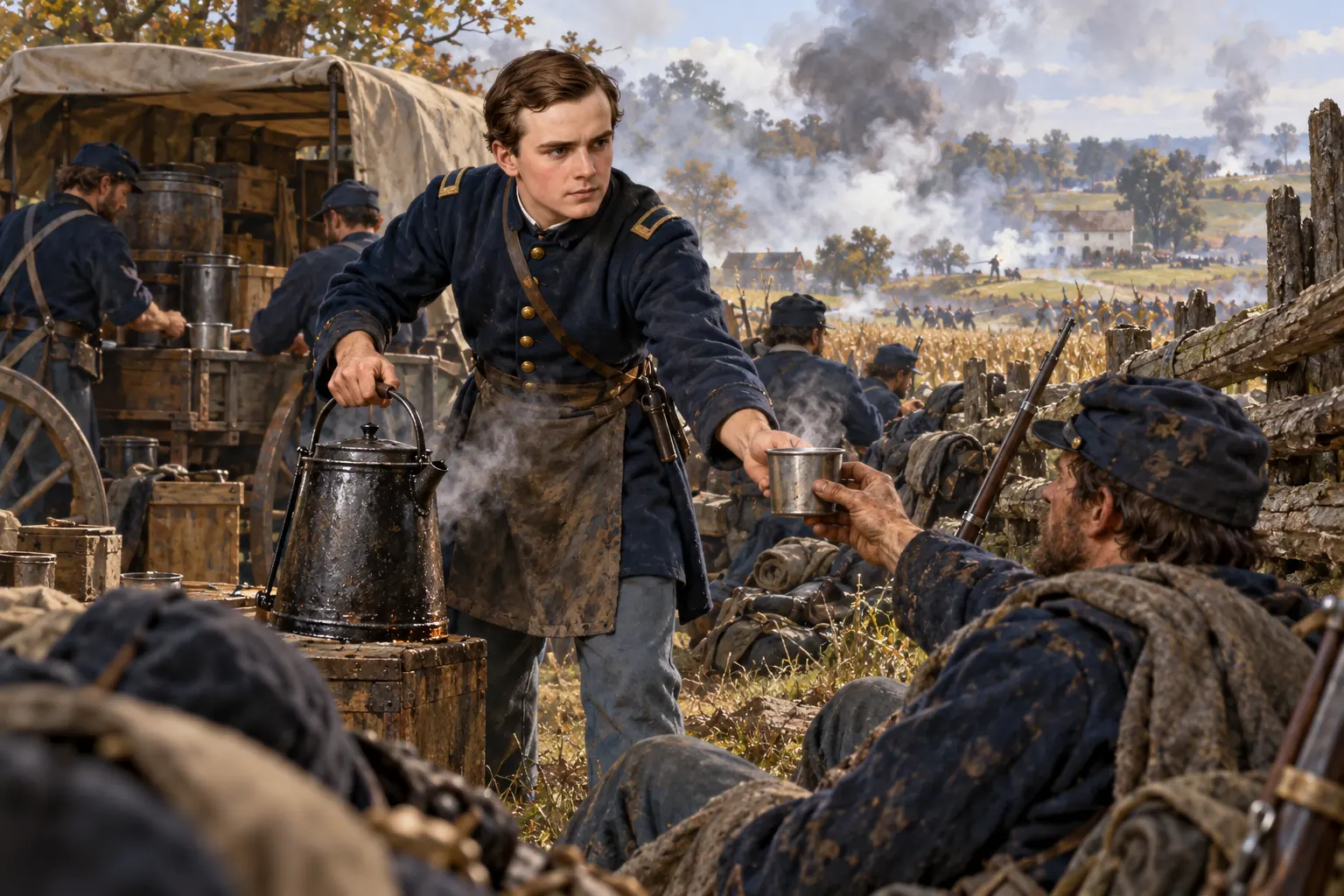
At Antietam in September 1862, the teenage McKinley was a commissary sergeant in the 23rd Ohio Infantry. He carried hot coffee and food to men under fire. The monument on the battlefield commemorates that particular act of supplying his regiment, rather than a charge or command. Rutherford B. Hayes, another future president associated with the regiment, later praised the service.
2. He defended striking miners against interests linked to Mark Hanna
Before becoming the politician closely associated with businessman Mark Hanna, McKinley represented miners charged after a violent Ohio strike. Charles Olcott's 1916 biography describes the mine as managed by Hanna's firm and says most defendants were acquitted. It also records that McKinley declined a fee from the impoverished workers. The episode complicates the later caricature of a lawyer and president whose career served only industrial owners.
3. A friend's failed business threatened his own finances
In 1893, while McKinley was governor, a friend whose bank loans he had guaranteed went bankrupt. The guarantees exposed McKinley to debts exceeding his resources. Supporters led by Mark Hanna raised money to settle the obligations, rescuing his finances and political prospects. This was a personal financial crisis during a national depression, years before he campaigned for the presidency on restoring prosperity.
4. His famous campaign house was partly a stage set
McKinley's 1896 front-porch campaign presented a candidate receiving voters at home in Canton. Yet the National Park Service notes that the couple primarily lived at the Saxton family house while their former newlywed residence served as the campaign's public face. Visitors came to a carefully organized political setting. The domestic image was real in its family connections, but it was also a managed piece of campaigning.
5. An early campaign film restaged a political event
In 1896, Biograph filmed McKinley at his Canton home in a recreation of his notification as the Republican nominee. His brother Abner, an investor in the company, helped arrange it. It was campaign publicity presented through a medium still in its infancy. McKinley's later inaugurations were filmed too, leaving moving images of presidential politics well before radio or television campaigning.
6. He changed formal dinner seating to stay beside Ida
White House protocol normally separated the president and first lady at formal dinners. McKinley instead sat beside Ida so that he could assist discreetly if she experienced a seizure. The accommodation did not mean that she withdrew from public life: she received guests, traveled and offered political opinions. Recent research by the National First Ladies Library challenges the older picture of her as permanently confined and incapable.
 You might also like
The First Founder: 15 Fascinating Facts About George Washington
7. Ida crossed into Mexico while he remained in the United States
During their 1901 western journey, Ida McKinley crossed from Texas to Ciudad Juárez for a luncheon on May 7. William did not accompany her across the border. The White House Historical Association identifies this as the first foreign visit by a sitting first lady. It is an especially revealing episode for a woman so often remembered chiefly through descriptions of illness and dependence on her husband.
8. His trademark flower became Ohio's state flower
McKinley regularly wore a carnation in his lapel and gave flowers to people he met. The McKinley Memorial Library traces his association with it to an 1876 congressional contest in which opponent Levi Lamborn wore a scarlet carnation. After the president's death, Ohio adopted the scarlet carnation as its state flower in 1904. The flower's documented public legacy is firmer than supernatural stories about his luck disappearing with it.
9. More than 21,000 Native Hawaiians petitioned against his annexation treaty
In 1897, McKinley submitted a treaty to annex Hawaii. Native Hawaiian opponents gathered 21,269 signatures on a petition, and delegates brought it to Washington. The treaty failed to secure the necessary Senate support. Annexation nevertheless followed through a joint resolution in 1898. The surviving bilingual petition preserves organized Hawaiian opposition that disappears from accounts describing expansion as an uncomplicated American achievement.
 US Presidents
Discover the eccentricities, secret talents, and surprising hidden lives of America's most influential presidents, from frontier wrestlers to covert strategists.
See All Facts
10. Victory over Spain led into another war in the Philippines
The Treaty of Paris transferred Spain's claim to the Philippines to the United States, with a $20 million payment. Filipino nationalists sought independence instead of a new colonial ruler, and fighting with American forces began in February 1899. The subsequent war extended beyond McKinley's lifetime. The State Department estimates that as many as 200,000 Filipino civilians died from violence, famine and disease, alongside the combatants on both sides.
11. He sent troops to China without a congressional declaration of war
When foreign diplomats were besieged during the Boxer crisis in 1900, McKinley dispatched American troops to join an international relief expedition. He acted without seeking a congressional declaration of war. At the same time, his administration's Open Door policy opposed carving China into exclusive foreign commercial territories. Protecting access to Chinese trade and extending presidential military power thus developed together.
12. His administration tested mail delivery across an entire rural county
Rural free delivery began experimentally in 1896, before McKinley took office. Under his administration, the Post Office Department enlarged the experiment: in December 1899, Postmaster General Charles Emory Smith ordered county-wide service in Carroll County, Maryland, replacing numerous small offices and contracted routes. The trial helped establish that delivery to farms could work on a much larger scale. Permanent national authorization followed in 1902.
13. A White House anniversary showcased a dramatic expansion model
At the capital's centennial celebration in December 1900, visitors to the White House saw a plaster model of Colonel Theodore Bingham's proposed expansion. Large cylindrical wings with domes would have supplied office, public and entertaining space beside the mansion. Architects sharply criticized the scheme, and it stalled. The building familiar today emerged through a different renovation after McKinley's death.
14. An X-ray machine arrived after his shooting but was never used
After McKinley was shot on September 6, 1901, surgeons closed the stomach wounds but could not locate the bullet. An aide arranged for Thomas Edison to send an X-ray machine to Buffalo; the National Library of Medicine records that it arrived unused. Initial medical reports offered hope, but infection developed and McKinley died on September 14. The unused machine is a historical fact, not proof that using it would have saved him.
15. His final public speech warned against commercial isolation
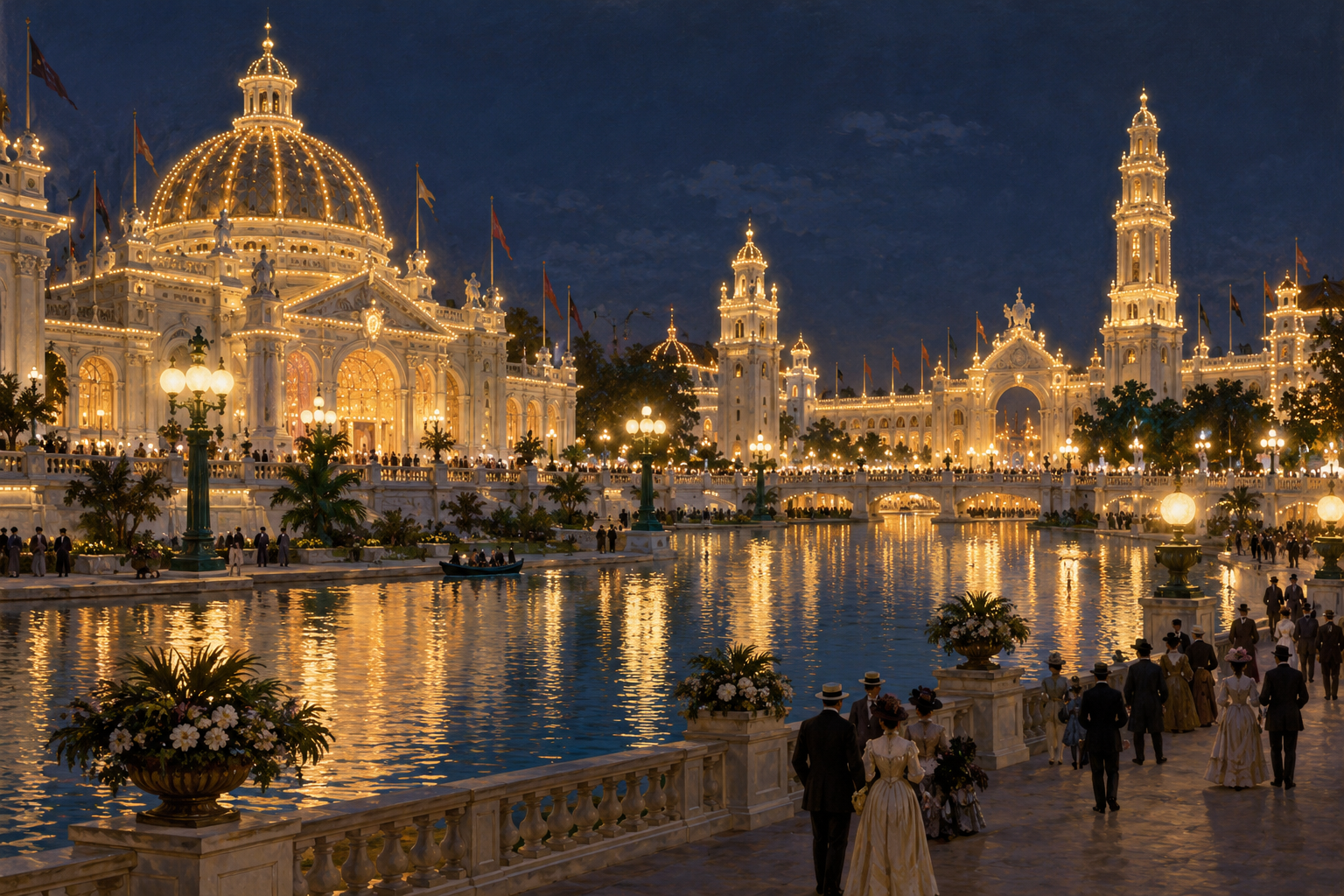
On September 5, 1901, at Buffalo's Pan-American Exposition, the politician famous for protective tariffs urged reciprocal trade arrangements. He argued that America could not expect to sell everything abroad while buying almost nothing, and that unnecessary tariffs could help win access to foreign markets. He was shot the following day. Reading the speech itself reveals a more flexible trade argument than his tariff-centered reputation suggests.
How did these facts land?
Know someone who'd love these facts? Share them 👇